Case Studies
Engineering Absorbent Solutions for the PET vs. Foam Transition
Executive Summary
As the food packaging industry shifts from expanded polystyrene (EPS) foam to clear PET trays, the physics of fluid management has fundamentally changed. TiteDri has engineered specialized absorbent pads that account for the unique surface tension and visibility challenges inherent in rigid, transparent plastic packaging.
The Challenge: "The Nest" vs. "The Slide"
In traditional Foam (EPS) Trays, the material is naturally insulating and slightly textured, which helps "grip" both the pad and the liquid (purge). This allows for more margin of error in pad sizing, as the foam’s curvature and friction help channel liquid toward the center.
In contrast, PET Trays are smooth, non-polar, and rigid. This creates a "waxed car" effect where liquid slides instantly to the lowest point. If a pad does not provide edge-to-edge coverage, the purge bypasses the absorbent core entirely and pools in the corners.
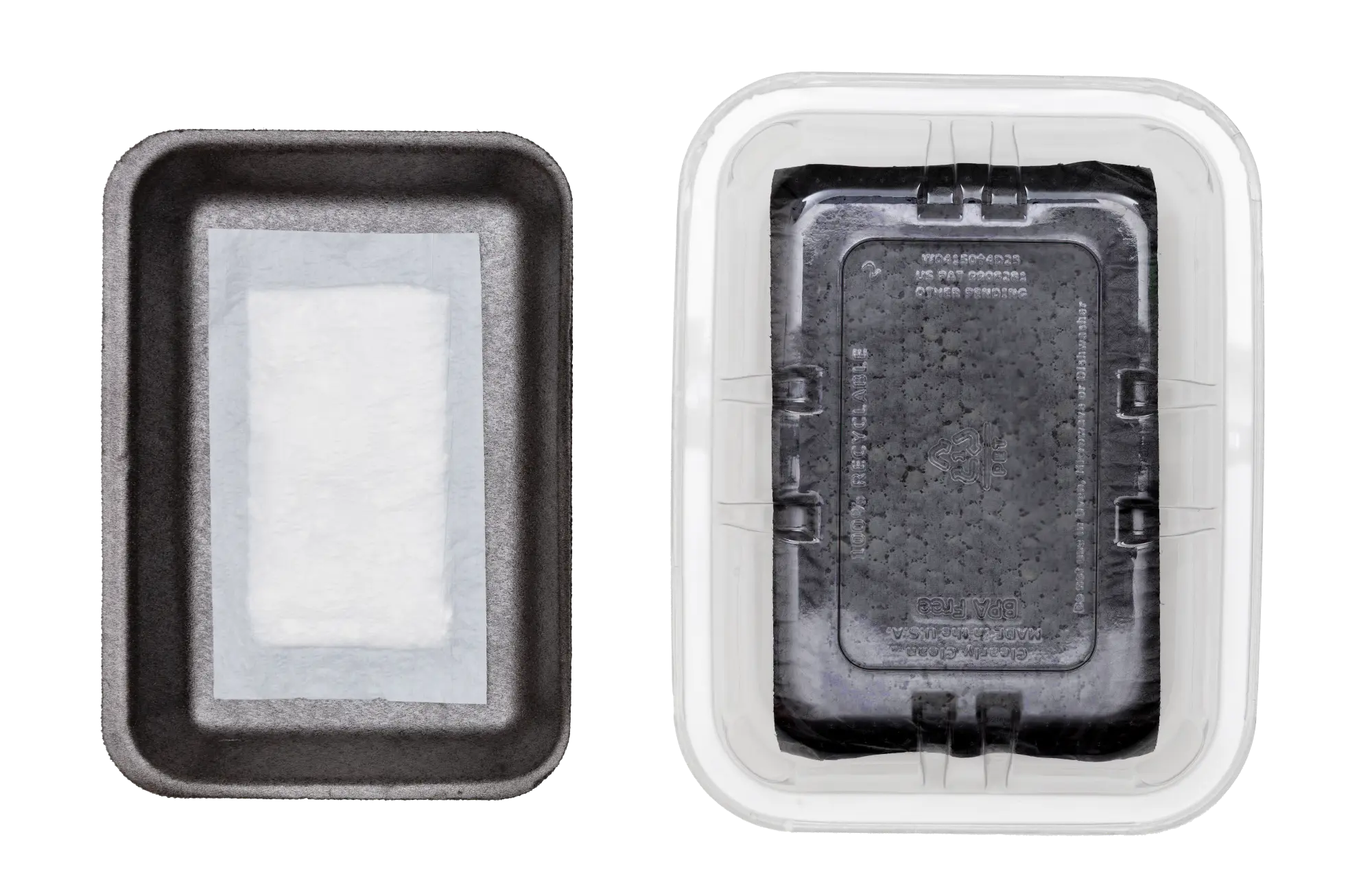
Why Precision Sizing is Critical in PET
Precision in pad dimensions is significantly more vital in PET applications for two primary reasons:
- Total Visibility: Because PET is transparent, any unabsorbed liquid is visible from the side and bottom. Consumers associate pooled "bloody" liquid with a lack of freshness, making visual management a top priority.
- Surface Tension & Speed: On smooth plastic, liquid moves faster than on porous foam. Edge-to-edge coverage is required to intercept the purge before it reaches the sidewalls of the tray.
- Comparison of Pad Design Requirements
To address these physical differences, TiteDri has developed distinct engineering profiles for each tray type:
| Feature | Foam Tray Pads (Standard) | PET Tray Pads (High-Performance) |
|---|---|---|
| Sizing vs. absorption | Absorption can be achieved with non-optimal size pads. | Size is critical to achieving required absorption. |
| Absorption Speed | Standard acquisition rates. | Ultra-fast Acquisition Layers required to "grab" liquid before it slides to the corners. |
| Aesthetics | Generally plain white. | Color-matched (Black, Yellow, or Red) to blend with the product and hide absorbed purge. |
Conclusion
The transition to PET trays requires more than just a change in container; it requires a re-engineering of the absorbent insert. TiteDri’s PET-specific pads ensure that high-speed fluid migration is controlled, preserving both food safety and the premium visual appeal that clear packaging is intended to provide.
Optimizing Supply Chain & Performance via Ultra-Airlaid Transition
Executive Summary
TiteDri successfully migrated a high-volume international client from traditional fluff pulp pads to advanced Ultra-Airlaid technology. This transition resulted in superior product performance, a considerable increase in shipping density, and a significant reduction in warehousing overhead.
1. The Challenge
A major international manufacturer was utilizing over 20 million "classic" 25g cellulose (fluff pulp) pads monthly. While functional, the existing solution presented significant logistical and operational bottlenecks:
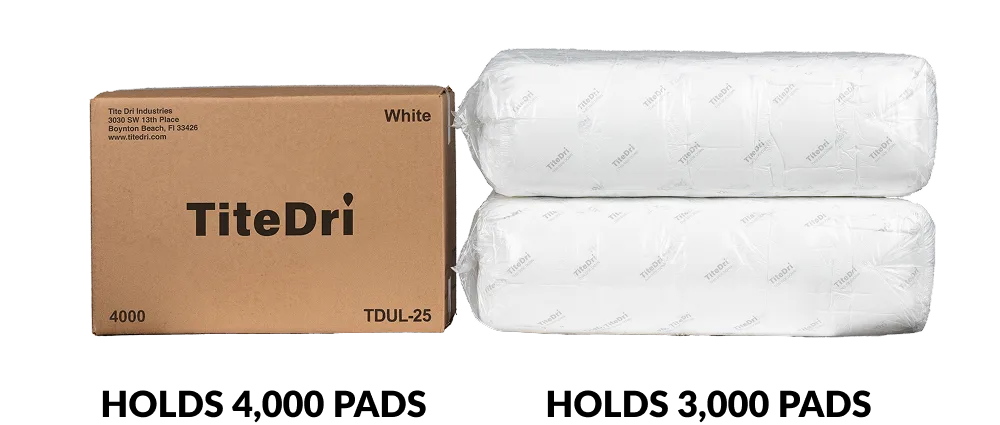
Low Shipping Density: Shipments were capped at 3.5 million units per truckload.
Packaging Inefficiency: Plastic-bundled packaging led to pallet instability and limited stacking heights.
High Storage Costs: The bulk volume of the fluff pulp required extensive warehouse square footage.
2. The TiteDri Solution
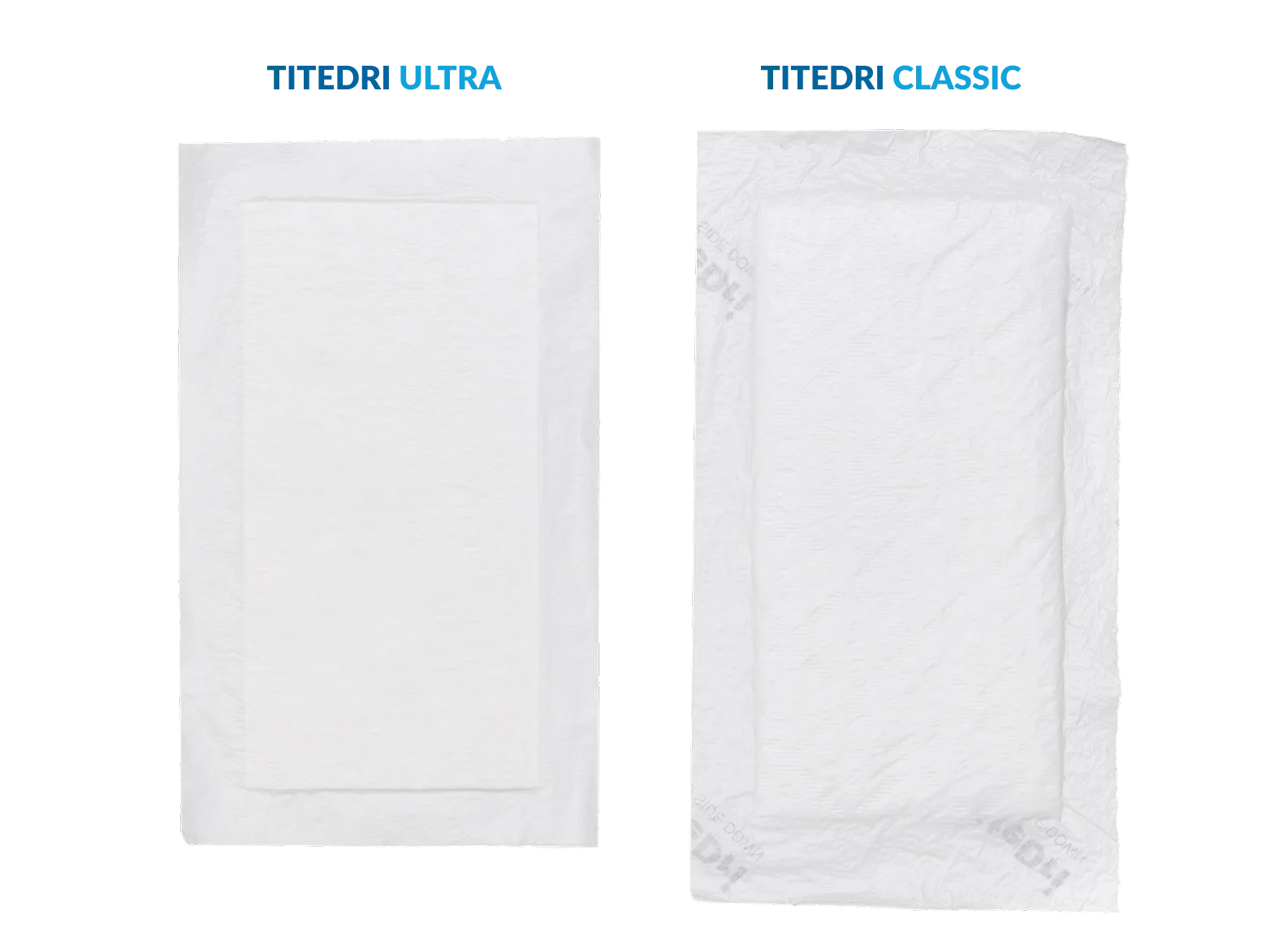
TiteDri engineered a high-performance Ultra Pad utilizing a specialized airlaid core. By integrating cellulose fibers with superabsorbent polymers (SAP), TiteDri matched the footprint and absorption capacity of the incumbent product while drastically reducing its physical profile.
Key Technical Enhancements:
Material Shift: Transitioned from loose-fiber fluff pulp to a structurally stable, nonwoven airlaid fabric.
Advanced Packaging: Moved from unstable plastic bundles to compressed bags housed in stackable corrugated cases.
SAP Integration: Leveraged airlaid technology to securely trap SAP, allowing the pads to retain up to 200% of their weight in fluids.
3. The Results
The transition to Ultra-Airlaid pads delivered immediate improvements across the client's entire value chain:
Logistical Optimization: Increased truckload capacity from 3.5 million to 12 million pads per load 3.5x improvement in freight efficiency.
Warehousing Efficiency: The thinner profile and stackable case design reduced required storage space by 75–80%.
Superior Product Integrity:
Low Rewet: Prevented fluid migration back onto food surfaces, extending shelf life and reducing bacterial risk.
Rapid Acquisition: The porous airlaid structure provided faster fluid absorption and more even distribution compared to traditional tissue.
High Wet Strength: Unlike standard cellulose, the airlaid core maintained structural integrity when saturated, eliminating fiber shedding.
Conclusion
By upgrading to TiteDri Ultra-Airlaid technology, the customer transformed a high-volume commodity purchase into a strategic advantage, drastically lowering their carbon footprint and operational costs while delivering a more premium product to the end-user.
Advancing Asparagus Hydration Through High-Loft Airlaid Technology
Executive Summary
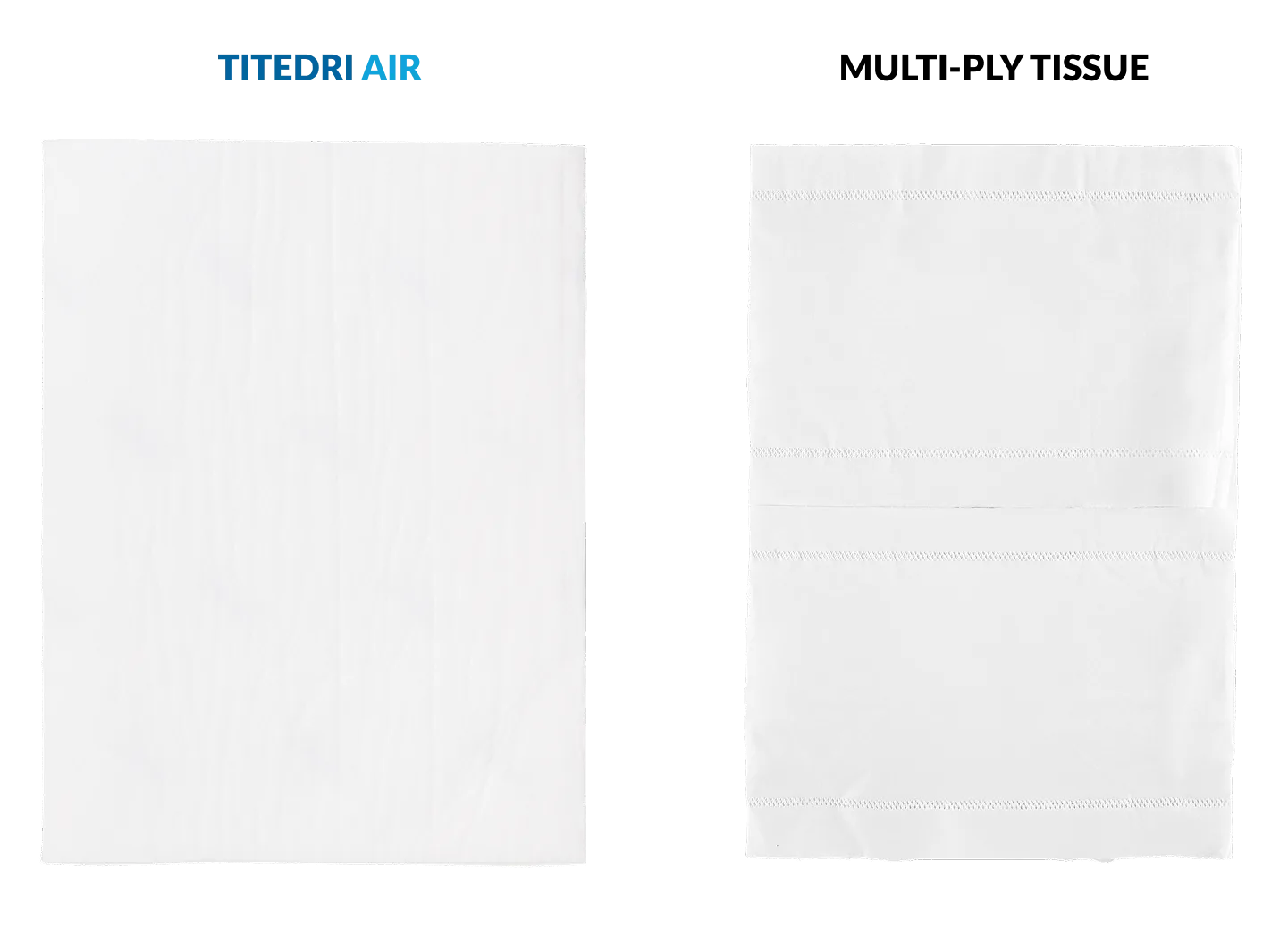
TiteDri partnered with key material suppliers to disrupt the traditional asparagus packaging market. By replacing multi-ply tissue with a custom High-Loft Airlaid core, TiteDri improved hydration delivery, enhanced product aesthetics, and eliminated the common failures associated with saturated paper pads.
1. The Challenge
Asparagus requires constant moisture at the root during transit to maintain freshness and prevent degradation. The industry standard has long been a 10-to-20-ply recycled tissue pad laminated to a film. However, these traditional pads face several performance issues:
- Structural Failure: Tissue layers often disintegrate or become "soggy" when fully saturated.
- Inefficient Moisture Release: While they hold water, they lack the capillary action to deliver it to the plant in a controlled, consistent manner.
- Unappealing Aesthetics: Traditional pads often look messy and "pulpy" once they reach the end consumer.
2. The TiteDri Innovation
In response to market demands for a more reliable hydration solution, TiteDri developed a specialized High-Loft Airlaid Pad. Unlike the layered construction of tissue, this airlaid material is a cohesive, nonwoven structure designed specifically for fluid management.
Key Technical Advantages:
- Superior Wicking: The airlaid structure acts as a precision "wick," drawing water upward and delivering it to the asparagus roots more efficiently than gravitational soaking.
- Controlled Release: The pad maintains a steady moisture profile, extending the freshness window during long-range shipping.
- High Integrity: The high-loft fibers maintain their shape and "bounce" even when wet, preventing the flat, collapsed look of traditional paper.
3. The Results
The transition to TiteDri Airlaid technology provided immediate benefits for both the packer and the retailer:
- Optimized Performance: The superior wicking capability ensured that every stalk in the bundle received uniform hydration, reducing spoilage at the retail level.
- Premium Presentation: The TiteDri pads maintained a clean, white, professional appearance throughout the entire supply chain—before, during, and after use.
- Low-Profile Efficiency: By achieving the same absorption capacity as a 20-ply tissue pad with a thinner, high-loft material, TiteDri reduced the overall bulk of the packaging.
Conclusion
While traditional tissue pads rely on volume to hold moisture, TiteDri focuses on performance. The result is a more efficient, better-looking, and more reliable hydration solution that protects the value of the crop from the farm to the kitchen.
Optimizing Operational Efficiency via Single-Lane Festooning
Executive Summary
To prioritize customer uptime and line stability, TiteDri bypassed the more cost effective "multilane" festooning in favor of a specialized Single-Lane Festooning system. Despite higher internal production costs, this transition—combined with TiteDri’s high-density thin pads—has allowed customers to achieve considerably higher pallet density and a significant reduction in machinery downtime caused by tangles and jams.
1. The Challenge
In the late 1990s, multilane festooning became the manufacturing standard because it allowed producers to fold multiple columns of material simultaneously. However, this "manufacturer-first" approach creates several critical failure points for the end-user:
- Rotational Twist: Lanes must be spliced with a 360-degree twist to prevent material knots, often leading to feeding errors.
- Column Instability: Material is pulled vertically from the box. As columns are depleted, the remaining stacks becomes unstable and prone to collapsing, causing tangles and line jams.
- Frequent Changeovers: Standard competitor packaging typically limits capacity, forcing operators to change "gaylords" (bulk boxes) 3 to 4 times per shift.
2. The TiteDri Innovation: Single-Lane Engineering
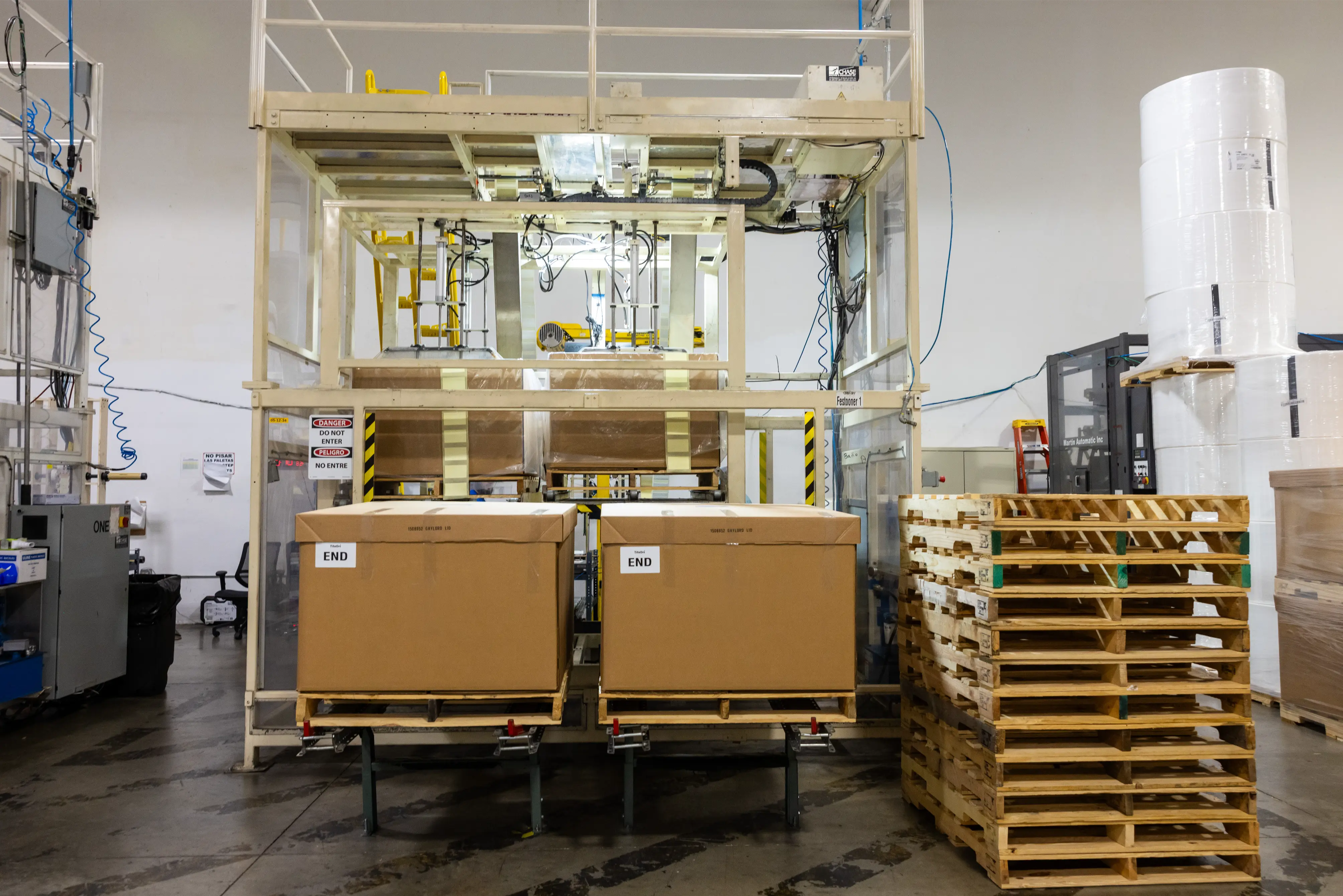
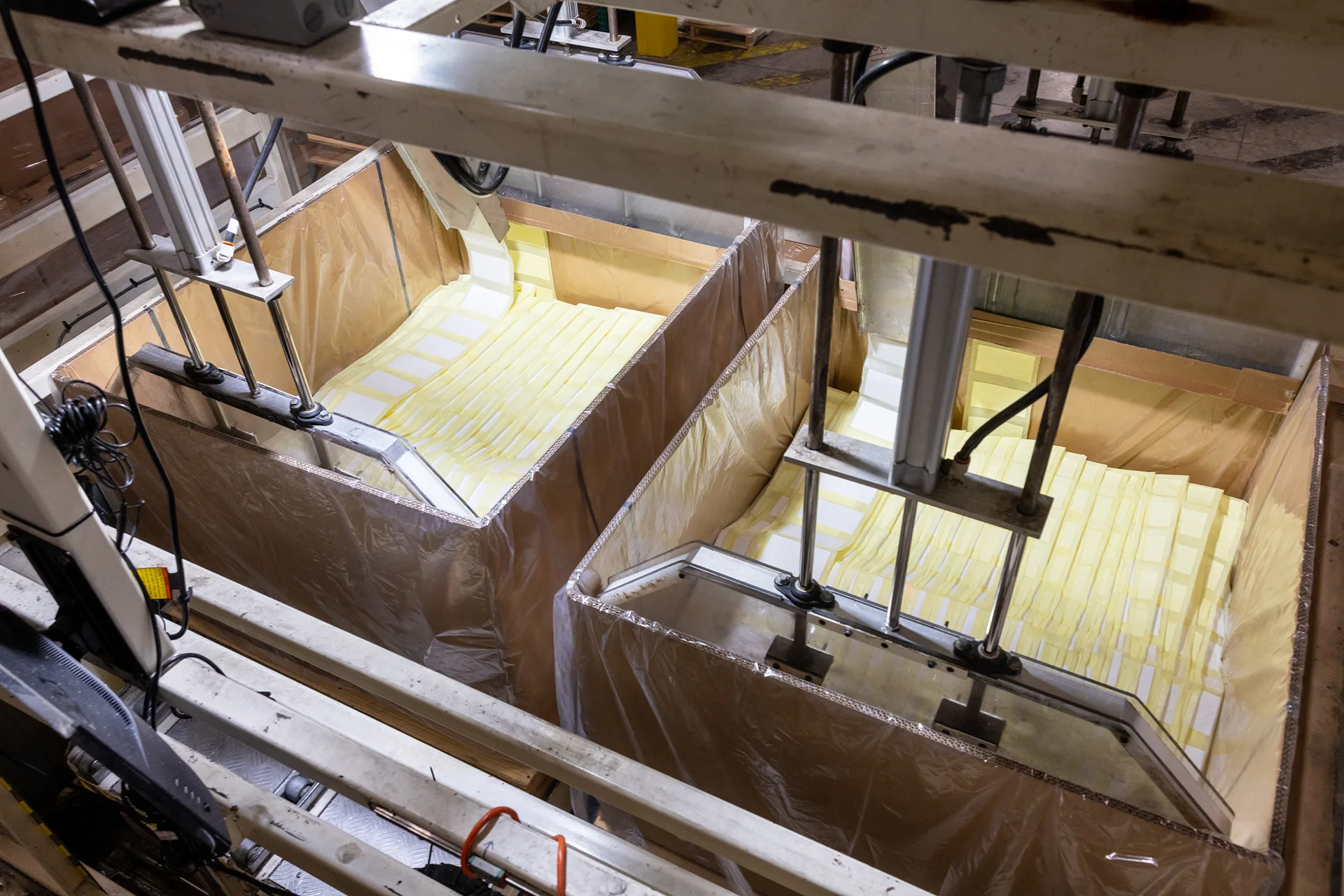
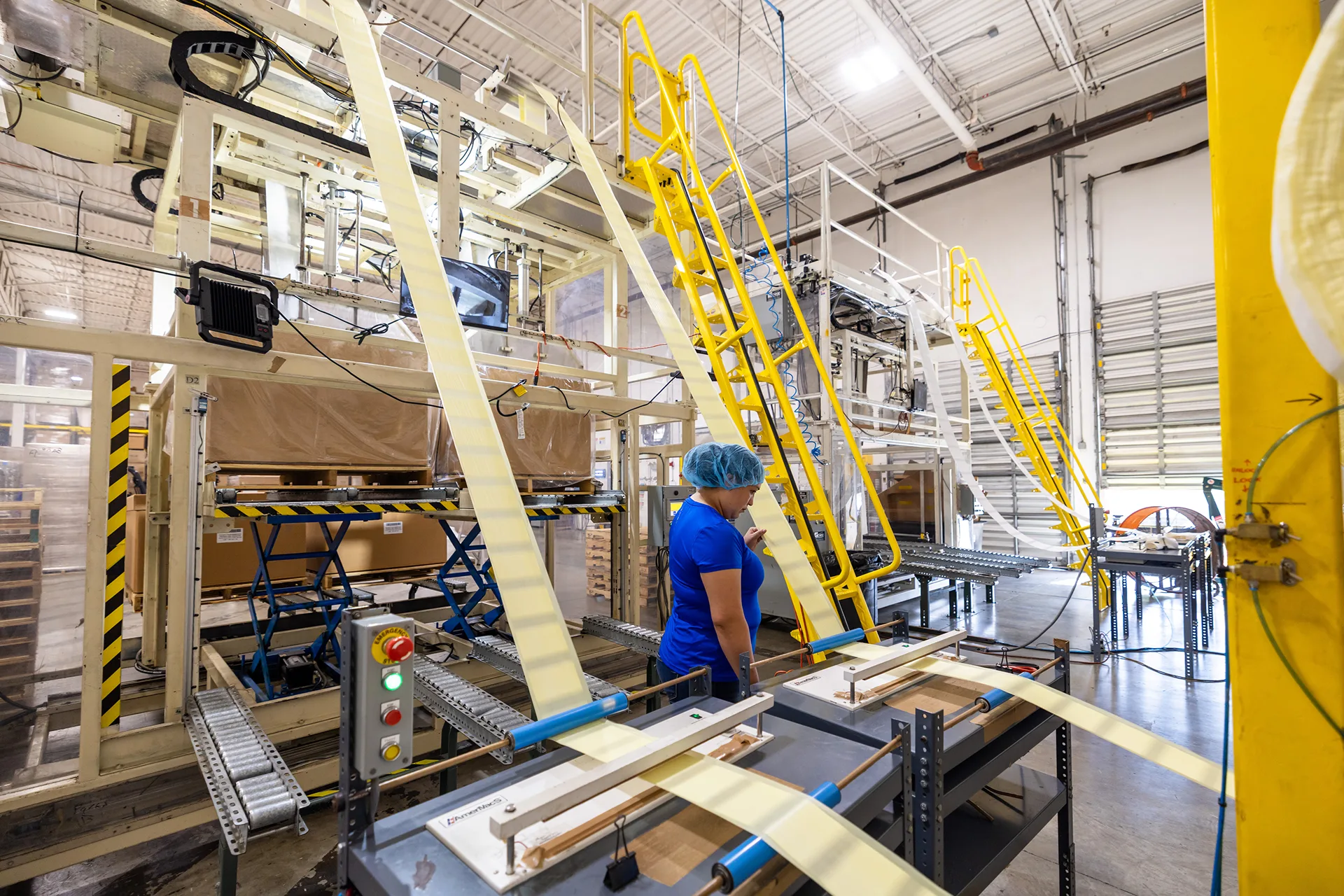
Drawing on decades of experience in festooning technology, TiteDri invested in a Single-Lane Festooning process. This system lays down a single, continuous layer of material moving laterally to fill the box from the bottom up.
3. Key Technical Advantages:
Gravity-Stabilized Feeding: The box is depleted from the top down. Gravity holds the remaining material firmly in place, virtually eliminating the risk of collapses and tangles.
- Splicable Ends: TiteDri pads feature engineered splicable ends, providing a continuous web of material that keeps high-speed converting lines running without the need for expensive, sophisticated unwinding systems.
- High-Density Compression: By combining single-lane folding with TiteDri’s thinner pad profile, the system maximizes every square inch of the shipping container.
Performance Comparison: TiteDri vs. Multilane Competitors:
| Feature | Multilane Competitors | TiteDri Single-Lane System |
|---|---|---|
| Feeding Reliability | High risk of tangles as columns become unstable. | Gravity-held layers ensure jam-free feeding. |
| Material Continuity | 5–6 separate strips prone to intertwining. | One continuous strip for seamless operation. |
| Load Density (200g pad) | ~50,000 statistical pads per 4' Gaylord (6" by 4" equivalent). | ~90,000 statistical pads per 2.5' Gaylord (6" by 4" equivalent). |
| Operator Efficiency | 3–4 Gaylord changes per shift. | 1-2 Gaylord change per shift. |
| Production Uptime | Standard throughput. | +30–60 minutes of run-time per shift. |
| Warehouse Footprint | Stacks 2-high in racks. | Stacks 3-high, reducing space needs by 33%. |
Conclusion
TiteDri’s commitment to Single-Lane Festooning transforms the absorbent pad from a simple commodity into a tool for operational excellence. By focusing on the "final user benefit," TiteDri allows customers to run longer, stack higher, and eliminate the costly downtime associated with traditional multilane packaging.
Enhancing Shelf Life and Sustainability with TiteDri “Cloud”
Executive Summary
For high-value produce like berries, stone fruits, and grapes, TiteDri has identified that traditional cellulose padding is insufficient for long-range transit. By introducing “Cloud”, a revolutionary recyclable pad featuring a High-Loft Nonwoven core and 3D Apertured Film, TiteDri provides a dual-action solution that prevents physical bruising while stopping the spread of microbial decay, extending shelf life by an average of 2–3 days.
1. The Challenge: Balancing Protection and Prevention
In the fruit sector, packaging must solve two distinct problems to avoid "batch failure":
- The Physical Wound (Bruising): Soft fruits like raspberries and peaches are highly susceptible to impact. A single bruise releases ethylene gas and juices, which triggers a rapid decay chain reaction within the container.
- The Microbial Spread (Infection): Once a fruit leaks, the resulting juice acts as a "sugar-water bridge." In traditional packaging, this liquid allows mold and botrytis to migrate across the tray overnight, ruining the entire unit.
2. The TiteDri Innovation: The "Cloud" Pad
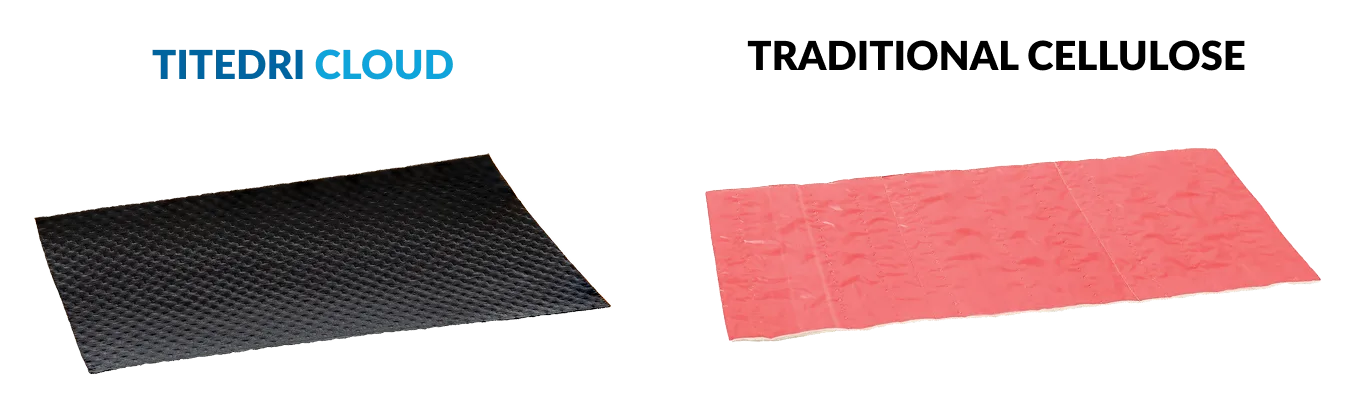
TiteDri replaces "old diaper technology" (loose cellulose) with the “Cloud” pad: a sophisticated, fully recyclable high-loft nonwoven structure designed for the specific rigors of produce exports.
Key Technical Enhancements:
- High-Loft Cushioning: Unlike cellulose, which collapses when wet, the Cloud nonwoven core maintains "spring-back" resilience. It acts as a miniature shock absorber that stays lofty throughout the cold chain to protect delicate skins.
- The "Funnel" Effect: Cloud utilizes 3D Apertured Film rather than standard 2D perforated layers. These funnel-shaped openings allow juice to enter the core easily but prevent "slugging" or rewetting, keeping the fruit surface bone-dry even when the pad is saturated.
- Sustainability: Engineered for the modern circular economy, the Cloud pad is designed to be recyclable, helping retailers and growers meet strict environmental mandates.
3. Performance Comparison: TiteDri Cloud vs. Traditional Cellulose:
| Feature | Traditional Cellulose Pads | TiteDri Cloud (High-Loft Nonwoven) |
|---|---|---|
| Structural Integrity | Collapses into a soggy mass when wet; zero rebound. | Maintains maximum loft and "spring-back" resilience even when saturated. |
| Moisture Management | High risk of "rewet"; liquid sits on the surface. | One-way fluid transfer keeps the contact surface dry. |
| Sustainability | Mixed materials; often non-recyclable. | Fully Recyclable construction. |
| Consumer Experience | Prone to sticking; causes fruit skin tearing. | Clean release; no fiber shedding or skin adhesion. |
| Shelf Life Impact | Standard transit windows; high waste risk. | Extends shelf life by 2–3 days for high-value exports. |
Conclusion
While cushioning prevents the initial "wound" to the fruit, superior absorption prevents the "infection" from spreading. For premium and export-grade produce, the TiteDri Cloud pad represents the new gold standard in loss prevention, quality maintenance, and environmental responsibility.